Classical Control Is Not Dead: Why Robots Still Need Physics
Updated
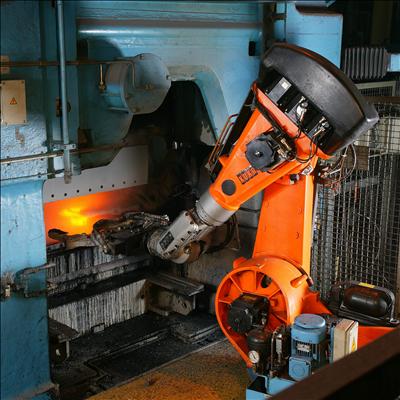
Robotics is now closely connected to AI. Every week there are new videos about humanoid robots, robot dogs, or learning algorithms that can do a task better than before. It is exciting, and I also like this direction.
But sometimes I feel the discussion becomes too simple. It can sound as if, once AI is strong enough, older control methods will no longer be needed.
I don’t think that is true.
A robot is not only software. It has mass, motors, friction, delay, cables, gears, and sometimes contact with a human or the ground.
So even if a policy is learned by AI, the robot still lives in physics. The body does not disappear.
Why classical control still matters
Classical and model-based control methods such as PID, computed torque control, impedance control, or model predictive control are not just old formulas. They give us a way to use what we already know about the system.
For example, if we know the dynamics of a robotic arm, we do not necessarily need to ask a neural network to learn all of that structure from zero. It can learn, yes. But it may need a lot of data, many failures, and possibly some unsafe actions along the way.
In real robots, that is not always acceptable.
A simple robot dynamics equation is usually written as
This equation is not the full reality, of course. But it is still useful. It tells us that torque is related to inertia, velocity-dependent effects, gravity, and the motion we want.
For me, this is the main point: physics gives us structure before learning starts.
Where AI can help
Learning-based control becomes especially useful when the model is not perfect. And the model is almost never perfect.
There may be friction that we did not model well. Mass properties can be uncertain. Sensors can be noisy. The environment can change. Sometimes the robot touches something and the contact is hard to predict.
In these places, learning can add useful compensation.
This is why I like residual learning. The nominal controller does the main job, and the learning policy only adds the part that the model-based controller is missing.
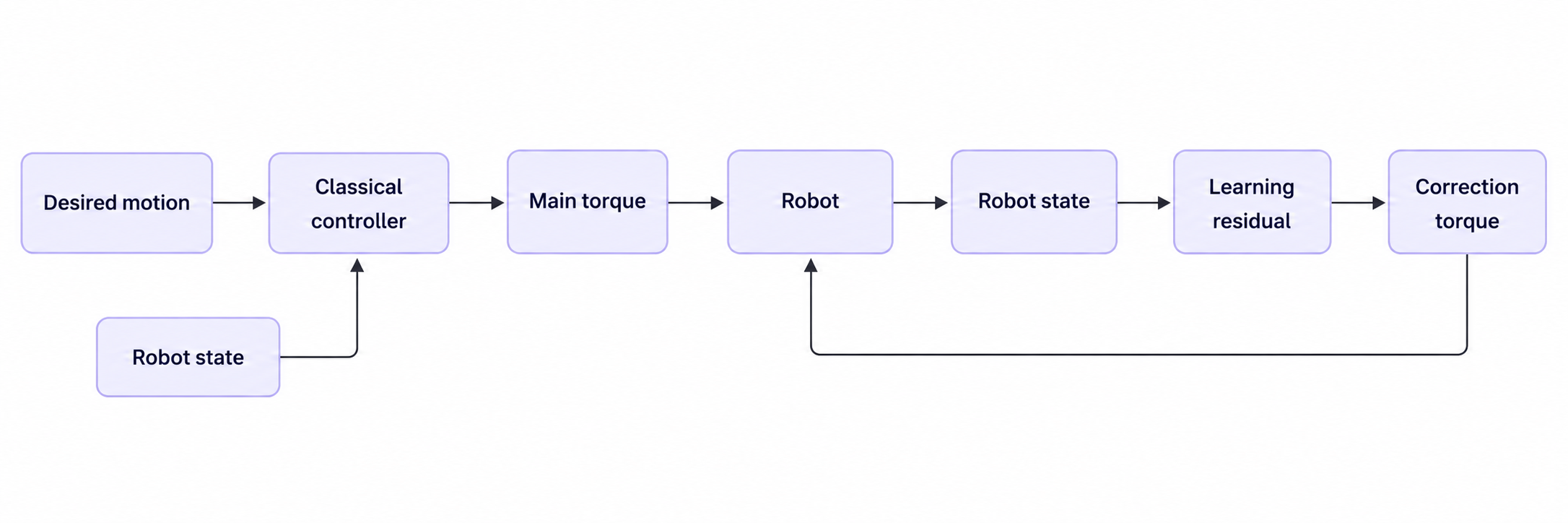
This is not “AI against control.” It is more like AI beside control.
Maybe that is less dramatic, but for engineering it makes more sense to me.
A small connection to my own work
In my M.Sc. thesis, I worked on a cable-driven lower-limb rehabilitation robot. I used computed torque control as the baseline, then added residual DDPG to reduce tracking error under disturbances and model uncertainty.
The important idea was not to remove the classical controller. I kept it because it already captures part of the robot dynamics. The reinforcement-learning component was added as a bounded correction.
In simulation, that hybrid controller tracked better than computed torque control alone in the tested non-nominal cases.
So for me this topic is not only a trend. My own work made the hybrid idea concrete: model-based control can provide the structure, while learning can compensate for effects that remain.
Why this matters more in robots than in normal AI
In text or image AI, a wrong output can often be corrected before it has a physical consequence. In robot control, a wrong command can move a motor, hit a limit, or apply too much force.
This is why control design is not only about performance. It is also about constraints, safety, predictability, and what happens when the model is wrong.
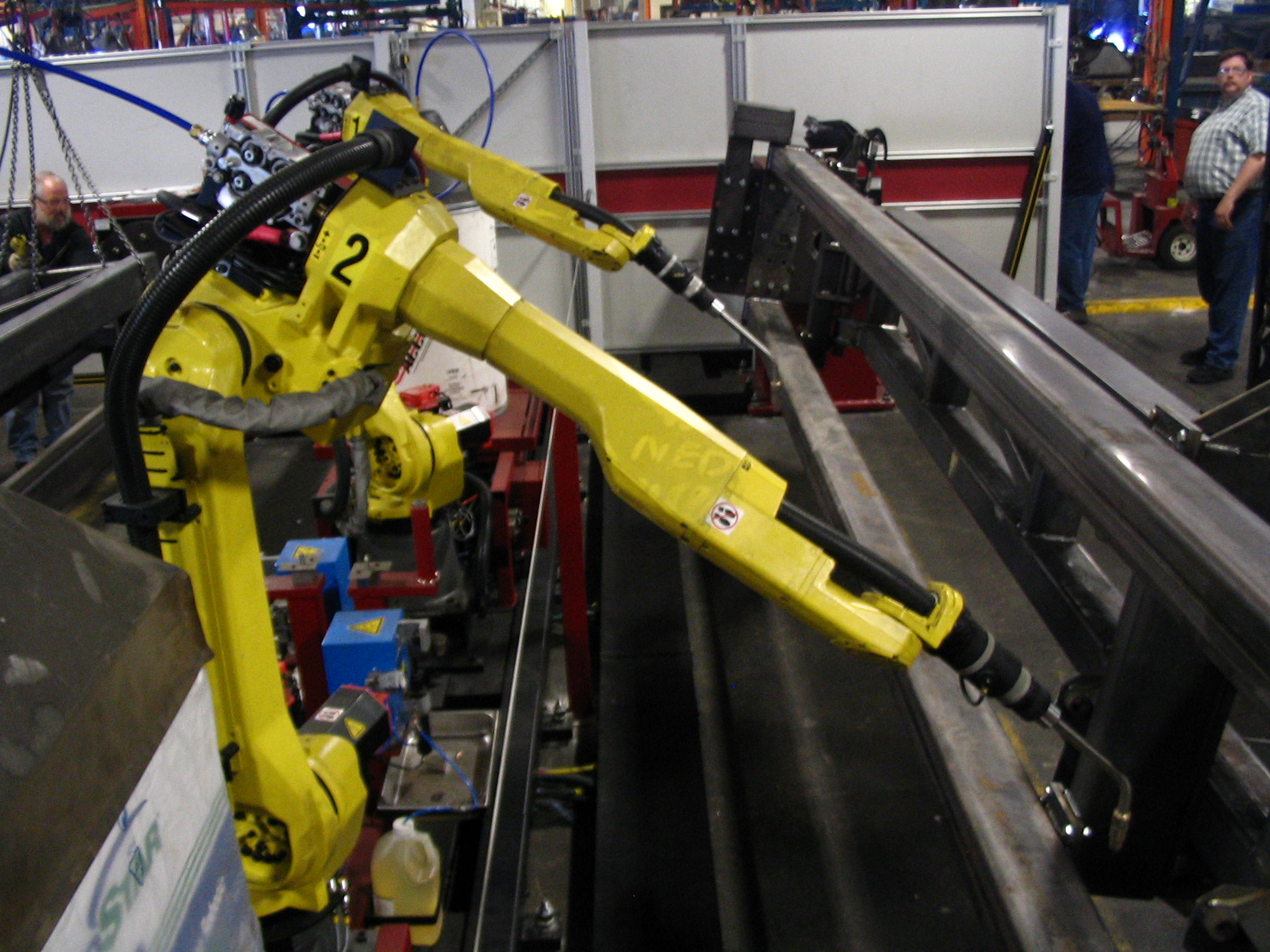
For industrial robots, rehabilitation robots, and mobile robots, we need systems that are not only smart in demo videos. They also need to behave reasonably outside the easiest nominal case.
Simulation is very useful for that, but simulation also depends on physics. If the model misses important actuator, contact, friction, or structural effects, a learned behavior can still fail when it is transferred to hardware.
My view
I don’t think classical control is dead. I think it is becoming one part of a larger stack.
A future robot controller may combine a physics model, a feedback controller, a safety layer, and a learning policy.
Some parts can be designed from equations. Some parts can be learned from data. The strongest system may come from using both where each is most useful.
So the question is not simply:
should we use control or AI?
A better question is:
what should be modeled, what should be learned, and where do we need safety boundaries?
That question may be less dramatic, but it is much closer to the engineering problem.
Image credits
classical-control-robot-foundry.jpg: Wikimedia Commons, Automation of foundry with robot.jpg, public domain.classical-control-fanuc-welding-robots.jpg: Wikimedia Commons, FANUC 6-axis welding robots.jpg, CC BY 3.0, author Phasmatisnox.residual-learning-control-flow.png: Simple diagram generated for this blog post.